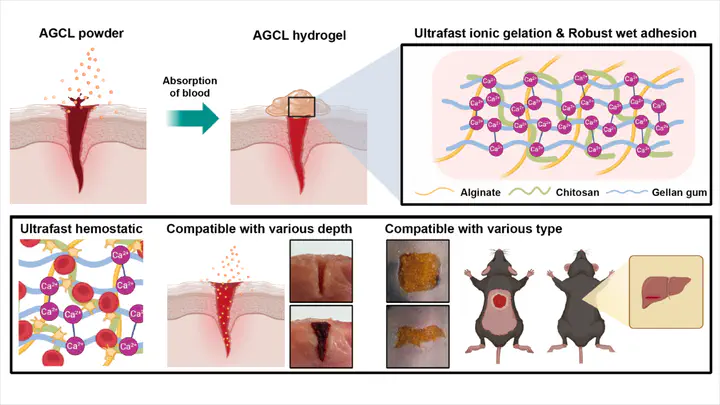
Rapid and effective bleeding control remains a clinical priority, particularly for deep or irregular wounds where conventional dressings are inadequate. Here, an ionically responsive, powder-based hemostatic system (AGCL) composed of alginate, gellan gum, chitosan, and a glutaraldehyde crosslinker is presented. Upon contact with calcium ions in blood, AGCL rapidly forms an adhesive hydrogel network within ≈1 s, enabling ultrafast gelation and a high blood uptake ratio (≈725%). The powder exhibits strong bioadhesion (>40 kPa), excellent sealing under mixed-mode loading, and robust storage stability for up to 24 months under ambient conditions. In vitro assays confirm minimal hemolysis (<3%), high cytocompatibility, and greater than 99% antibacterial efficacy. In various bleeding models, AGCL significantly reduced blood loss and time to hemostasis compared to TachoSil, a clinical benchmark. Furthermore, AGCL accelerated re-epithelialization, angiogenesis, and collagen deposition in murine skin and liver wound models, supporting high-quality tissue regeneration without systemic toxicity. These results demonstrate that AGCL integrates rapid coagulation, strong adhesion, long-term biostability, and regenerative capacity in a single platform. Its powder format offers distinct advantages in versatility, ease of application, and storability, making it a promising candidate for next-generation topical hemostats in trauma care, surgery, and emergency medicine.
Sukkyung Kang
My research focuses on the phenomena arising from the physical contact between two engineered surfaces. The goal is to develop processing technologies that can create high-value, innovative products by precisely manipulating phenomena such as friction, wear, polishing, bonding, diffusion, adhesion, and deformation.