12. Modeling framework and discussion of microstructural effects on the formation of Cu–Cu bonding interfaces in semiconductor stacking
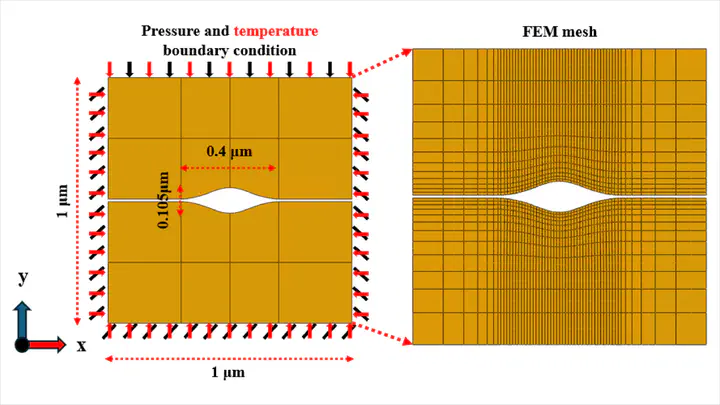
As computational costs increase with the increasing use of artificial intelligence, improving the performance and efficiency of semiconductor systems has become an unavoidable challenge. Bumpless bonding is considered an emerging technology for semiconductor stacking to increase input/output density. Some studies have aimed at precisely controlling the bonding temperature and pressure to achieve a reliable Cu–Cu bonding interface. Nevertheless, considerable variations in the interface have been observed, even under identical conditions, which are attributed to the influence of the Cu microstructure. Controlling the microstructure of Cu during bonding still faces many technical challenges, and insufficient research has been conducted. Although some experimental studies exist, they have not fully analyzed the complete mechanism of the microstructural effect, and studies on numerical analysis are lacking. This study developed a modeling framework and simulated the behavior occurring in Cu–Cu bonding by considering microstructural effects. To achieve this, the microstructural vector theory has been extended to consider the distortion of the atomic lattice caused by atomic flux and slip. The model was then implemented using the finite element method (FEM) through the ABAQUS user-defined material subroutine (UMAT). The numerical analysis results showed that the voids at the interface are more significantly affected by pressure than by temperature, and the combination of grains at the interface has a significant impact on interface formation. These simulation results were first used to mechanically analyze and discuss the experimental observations previously reported for Cu–Cu bonding. Furthermore, additional experiments and inverse pole figure (IPF) observations of the Cu–Cu bonding interface were conducted, and the results were found to be consistent with the trends predicted by the model. The research findings demonstrate that the microstructure has a significant impact on the bonding interface formation and confirm the potential for controlling the bonding interface through microstructural control.
Sukkyung Kang
My research focuses on the phenomena arising from the physical contact between two engineered surfaces. The goal is to develop processing technologies that can create high-value, innovative products by precisely manipulating phenomena such as friction, wear, polishing, bonding, diffusion, adhesion, and deformation.